


Standard EOR fees of $599 monthly often balloon by 30% to 60% due to hidden layers like currency markups and inflated benefit premiums. While platforms market low entry prices, the actual cost for a single employee can reach $1,100 per month once administrative surcharges and exit fees are factored in. You might believe your global expansion budget is under control, but these invisible expenses frequently lead to significant financial strain or startup failure.
Let’s take a look at the reality of EOR Hidden Costs to help you identify where your capital is leaking and how to regain transparency in your international hiring strategy.
Understanding EOR Hidden Costs in Global Hiring
Standard EOR fees of $599 monthly often balloon due to 1-3% currency markups and $1,000 termination fees. Direct hiring or HR outsourcing typically offer better long-term ROI and transparency for European expansion.
This financial reality contrasts sharply with the low entry prices marketed by major global platforms.
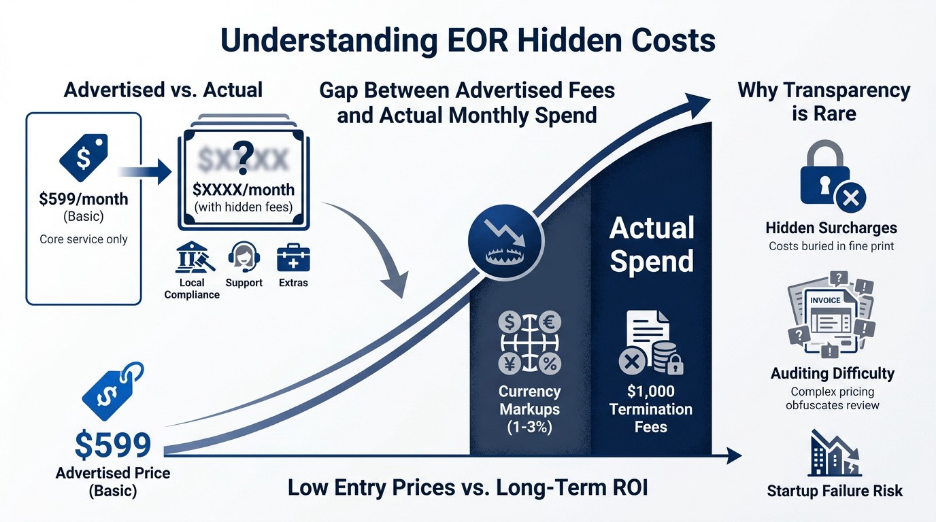
The Gap Between Advertised Fees and Actual Monthly Spend
Providers often lure companies with monthly fees between $400 and $700. Yet, the final invoice frequently surprises managers. Basic tiers often exclude necessary local compliance or specialized support.
These extra layers can add thousands in annual expenses per worker. Data from crunchbase regarding the $599 average monthly cost shows how quickly budgets erode. It is a systematic issue.
Budget providers frequently hide the highest percentage of extras. They attract startups with low base rates. Then, they upsell features that are actually mandatory for legal operations.
Why Price Transparency is Rare in Global Employment
Most providers fail to disclose administrative surcharges clearly. These fees remain buried in complex terms. Companies often discover them only after the first payroll cycle begins.
Auditing monthly invoices from global providers is notoriously difficult. Invoices group costs together. This makes it impossible to identify individual markups, currency spreads, or specific tax calculations for each employee.
Requesting a full cost breakdown is a fundamental step. We suggest never signing a contract without a line-by-line simulation. Transparency should be a prerequisite, not a luxury.
Hidden disclosures often lead to excessive spending and startup failure. Direct hiring or specialized HR outsourcing often provide more predictable financial outcomes for growing businesses.
Currency Markups and Foreign Exchange Traps
While base fees are visible, the most insidious costs often hide within the currency conversion process itself.
The Hidden Margin in Interbank Rate Spreads
Providers often apply a silent markup of 1% to 3% on local payroll funding. This spread acts as a significant profit center that many clients fail to notice during negotiations.
On a typical 40,000 EUR salary, a 2% spread results in an 800 EUR annual loss. This extra cost provides no added value and purely inflates the provider’s bottom line.
Many EORs profit by using internal exchange rates instead of the mid-market rate. They rarely disclose these margins unless specifically pressured to provide transparency regarding their conversion methods.
Understanding these financial layers is as vital as knowing the tax implications of using an Employer of Record (EOR). Hidden fees can quickly erode your international expansion budget.
Managing the Impact on High Salary Sales Roles
Currency volatility significantly increases financial risk for the employer. Large commission payments made in foreign currencies often lead to massive, unpredictable spikes in monthly invoices that disrupt cash flow.
We recommend demanding the interbank rate within your service contracts. You should insist on funding payroll in the employee’s local currency to bypass the provider’s inflated internal exchange markups.
Non-transparent exchange practices create compounding costs that grow over several years. In many cases, these hidden margins make the EOR model far more expensive than maintaining a local bank account or using direct HR outsourcing.
Benefit Inflation and Mandatory Administrative Add-ons
Beyond the payroll itself, the statutory and supplementary benefits provided through an EOR often carry heavy surcharges. These expenses frequently go unnoticed until the first detailed invoice arrives at your desk.
Kickbacks and High Premium Health Insurance Choices
EORs often select insurance providers based on administrative ease or hidden commissions. These partnerships rarely favor the client’s budget. Instead, they prioritize the provider’s own internal operational convenience or financial incentives.
Standard healthcare packages through an EOR typically carry a 15% to 30% markup. This inflation directly impacts your bottom line. Consider these typical cost comparisons:
- Standard local premium cost – base market rate
- EOR premium cost – base rate + 30% markup
- Administrative fee for benefit management – additional monthly surcharge
We have observed that EORs rarely pass down volume discounts to their clients. Even when managing thousands of employees, the provider keeps the scale savings. You pay retail prices while they enjoy wholesale margins.
Equipment Allowances and Administrative Surcharges
Onboarding a new hire often triggers setup fees ranging from $500 to $2,000. These charges supposedly cover basic administrative tasks. In reality, these are routine processes that should be part of the standard service.
Standardizing equipment through third-party vendors often leads to inflated costs. EORs frequently mandate specific suppliers for laptops and desks. These vendors charge premium rates compared to local retail options available to direct employers.
Every small administrative update can trigger a change request fee of $100 or more. Whether it is a job title change or a contract modification, the costs accumulate. Direct hiring or traditional HR outsourcing remains a much more cost-effective alternative for growing teams.
Exit Costs and Notice Period Financial Liabilities
The true cost of an EOR is often only realized when the professional relationship ends. While the monthly fees seem manageable at first, the financial burden of offboarding can be a rude awakening for many businesses.
Termination Fees and Legal Compliance Surcharges
Offboarding fees typically range from $300 to $1,000 per person. These charges apply simply to process final payroll and tax filings. It is a steep price for administrative tasks.
Clients remain responsible for local severance and indemnity payments. In countries like Spain or Brazil, legal battles can be extremely costly. These mandatory payments are never covered by your monthly subscription.
Unexpected legal fees during employment disputes pose a significant risk. Since the EOR is the legal employer, they will pass all defense costs to you. You pay for their legal protection, not yours.
Platform Fee Continuation During European Notice Periods
Notice periods of 1 to 3 months create a heavy financial burden. In Europe, these periods are mandatory by law. The EOR will continue to bill you fully during this time.
EORs maintain platform fees even after the employee stops working. During “garden leave,” you still pay the monthly $600 management fee. The provider profits while no actual work is being performed.
The total exit cost for a failed 12-month engagement can be staggering. When combining notice pay, EOR fees, and offboarding surcharges, costs often reach $8,000.
Comparing EOR Against Direct Hiring and HR Outsourcing
Given these mounting expenses, savvy businesses are looking at sustainable alternatives for European teams. While the EOR model provides a quick entry point, the long-term financial burden often outweighs initial convenience compared to direct control mechanisms.
Direct Local Entity Setup for Larger Sales Teams
European markets reach a break-even point at 15 employees. Beyond this, fixed entity costs are cheaper than per-head EOR fees. This transition ensures long-term fiscal stability.
Local entities offer superior control and lower recurring costs. This avoids high markups from third-party intermediaries.
Direct hiring proves more economical after the first year by stopping fee accumulation. The following table compares costs and control levels between these models.
| Cost Category | EOR Model | Direct Hire | Verdict |
| Monthly Fee | High | Low | Direct Hire |
| Currency Markup | 1-3% | None | Direct Hire |
| Compliance | Limited | Full | Direct Hire |
| Setup Cost | Low | High | EOR |
| Flexibility | Moderate | High | Direct Hire |
| Long-term ROI | Lower | Higher | Direct Hire |
HR Outsourcing and Payroll Only Models for Cost Control
HR outsourcing offers transparency for small teams without EOR price tags. Managing payroll through local providers eliminates massive margins. It simplifies the cost structure immediately.
Direct payroll management retains employer status while reducing administrative overhead. This is effective in specific regions.
Removing the middleman reduces hidden markups and inflated benefit costs. Local payroll services provide transparency and lower monthly spend. This ensures funds support compensation rather than platform profits.
Wrapping Up
Navigating EOR hidden costs requires auditing currency markups, benefit inflation, and exit liabilities that often exceed advertised rates. By demanding transparent breakdowns and considering direct hiring for teams over 15 people, you protect your margins. Act now to secure your global expansion and ensure long-term profitability.
Frequently Asked Questions (FAQ)
What are the typical monthly costs for an Employer of Record?
While many EOR providers market entry-level fees between $400 and $700 per month, the actual invoice is often significantly higher. When accounting for hidden administrative layers and essential compliance features, the true monthly cost generally balloons to between $600 and $1,100 per employee. For a standard sales role with a €40,000 annual salary, these undisclosed expenses can add up to €5,200 in extra annual costs.
Budget providers often lure startups with low base rates only to upsell necessary features later. In contrast, direct hiring or specialized HR outsourcing models typically offer more transparent pricing structures. By removing the EOR middleman, companies can avoid these inflated monthly management fees that rarely provide long-term ROI as the team scales.
Are there hidden fees associated with currency exchange in EOR payroll?
Yes, currency markups are a silent profit center for many global EOR platforms. Most providers process payroll in local currency but bill the client in USD or EUR, applying a markup of 1% to 3% over the interbank rate. On a €40,000 salary, this “hidden tax” can cost an employer an additional €400 to €1,200 per year without providing any tangible service or value.
To avoid these foreign exchange traps, we recommend demanding the use of the mid-market interbank rate in your contract. Alternatively, establishing a local entity allows you to pay employees directly from a local bank account, completely eliminating the provider’s conversion margins. This level of financial control is one of the primary reasons why direct hiring is often the superior choice for European expansion.
How do EOR providers inflate the cost of employee benefits?
EORs often select insurance and pension providers based on administrative ease or hidden commissions rather than cost-efficiency for the client. This frequently results in health insurance premiums that are 15% to 30% higher than what a direct employer would pay. Furthermore, EORs rarely pass down volume discounts to their clients, even when managing thousands of workers globally.
Beyond insurance, you may encounter administrative surcharges for equipment allowances and mandatory “onboarding” fees ranging from $500 to $2,000. Every small change, such as a job title update or contract modification, can trigger additional “change request” fees of $100 to $300. These compounding costs make the EOR model significantly more expensive than managing benefits through a dedicated HR outsourcing partner.
What financial liabilities should I expect when terminating an EOR contract?
The true cost of an EOR often surfaces during offboarding, with termination fees typically ranging from $300 to $1,000 per person. In Europe, mandatory notice periods of one to three months mean you must continue paying the full EOR platform fee even if the employee is on “garden leave.” If a 12-month engagement fails, the total exit cost including severance and fees can reach up to €8,000.
Because the EOR is the legal employer, they will also pass all legal defense costs and settlement liabilities directly to you during any employment dispute. While EORs claim to simplify the process, the lack of control over local legal strategy can lead to excessive spending. Direct hiring provides the autonomy needed to manage these risks more effectively and at a lower total cost.
At what point is direct hiring more cost-effective than using an EOR?
In most European markets, the financial break-even point for moving from an EOR to a direct hiring model is approximately 15 employees. Once a team reaches this size, the fixed costs of maintaining a local legal entity are lower than the cumulative monthly platform fees and hidden markups charged by an EOR. Direct hiring offers superior long-term ROI and much tighter control over compliance.
For smaller teams, HR outsourcing or “payroll-only” models are often better alternatives to the traditional EOR. These models eliminate the massive margins and hidden surcharges associated with global employment platforms. By choosing a more transparent outsourcing path, you gain the benefits of local expertise without the inflated overhead of a middleman employer.